

Relevant 3rd Cycle Recommendations: 127.157; broad: 127. 166; 127.169
Context
During its third Universal Periodic Review, the Republic of Moldova accepted numerous recommendations concerning gender equality, including strengthening institutional mechanisms and gender mainstreaming across public policies (A/HRC/50/13). Since then, government decision No. 203/2023 reaffirmed the MLSP’s role in coordinating gender equality policies and strengthening gender mainstreaming capacities. In parallel, Government Decision No. 1/2022 integrated gender equality into the National Human Rights Council’s Subcommittee on Non-discrimination and Gender Equality.
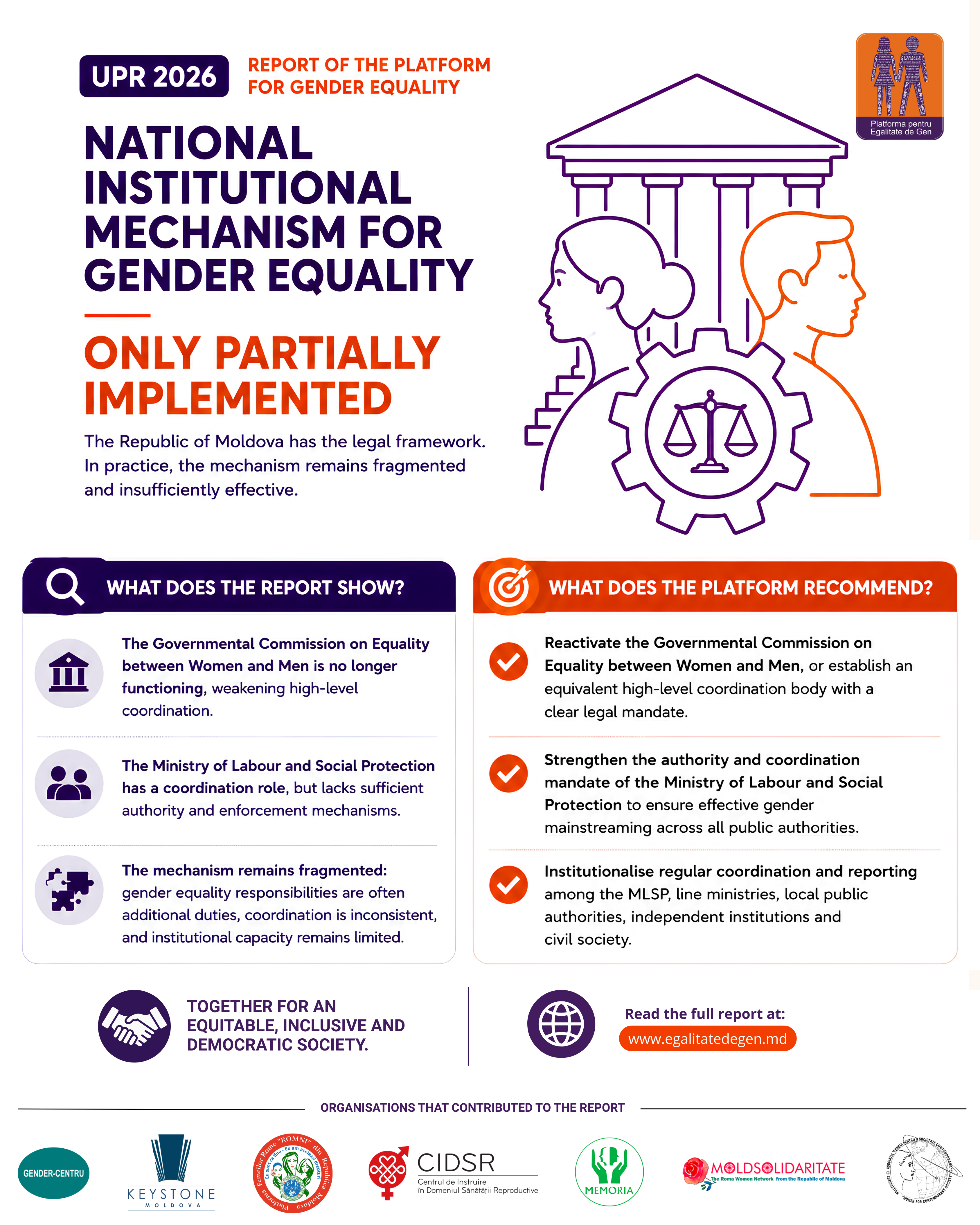
Despite these measures, there is still room for improvement. The Republic of Moldova has established a comprehensive legal framework for the institutional mechanism on gender equality under Law No. 5/2006 on Ensuring Equal Opportunities between Women and Men. However, the mechanism remains fragmented and ineffective in practice. The Ministry of Labor and Social Protection (MLSP) has formal responsibility for coordinating gender equality policies across government structures, but lacks sufficient authority and enforcement powers to ensure effective implementation by other ministries and public institutions. Moreover, the Governmental Commission on Equality between Women and Men – the central political coordination body established by law – has effectively ceased to function, significantly weakening high-level coordination and accountability. Furthermore, the integration of gender equality into a broader human rights subcommittee risks weakening the autonomy, visibility, and policy influence of the dedicated gender equality mechanism established under Law No. 5/2006. Finally, gender units and focal points continue to perform gender equality functions as additional responsibilities rather than dedicated positions, limiting institutional capacity and accountability while coordination between relevant institutions remains inconsistent. Given these remaining challenges, the recommendations of the 3rd UPR cycle have been only partially implemented.
Key Questions
- How does the Government ensure that the ongoing reform of the national human rights institutional framework complies with Law No. 5/2006 and preserves the independent legal mandate of the national gender equality mechanism?
- What concrete steps will be taken to strengthen the institutional authority and coordination capacity of the Ministry of Labor and Social Protection to ensure effective gender mainstreaming across all ministries and public authorities?
Recommendations
- Reactivate the Governmental Commission on Equality between Women and Men, or establish an equivalent high-level coordination body with a clear legal mandate, in accordance with Law No. 5/2006 and the recommendations of the CEDAW Committee.
- Ensure that institutional reforms preserve the distinct legal status and mandate of the national gender equality mechanism, avoiding its absorption into broader human rights structures without corresponding legislative amendments.
- Strengthen the authority and coordination mandate of the Ministry of Labor and Social Protection by providing adequate legal and institutional mechanisms to oversee gender mainstreaming across all public authorities.
- Institutionalize regular coordination and reporting mechanisms among the MLSP, line ministries, local public authorities, independent institutions, and civil society to ensure coherent implementation and monitoring of gender equality policies

Comentarii sunt blocate.