

Relevant 3rd Cycle Recommendations: 127.157-158 ; 127.160-163 ; 127.165-166; 127.169
Context
Gender-responsive budgeting (GRB) requires allocating and spending public funds in ways that respond to the different needs of women and men and reduce inequalities. In its third review (January 2022), Moldova accepted recommendations on gender equality relevant to public finance and women’s economic empowerment. Since then, the Ministry of Finance issued an annual budget cycle in 2024 with mandatory GRB provisions which has been applied to a few pilot ministries.
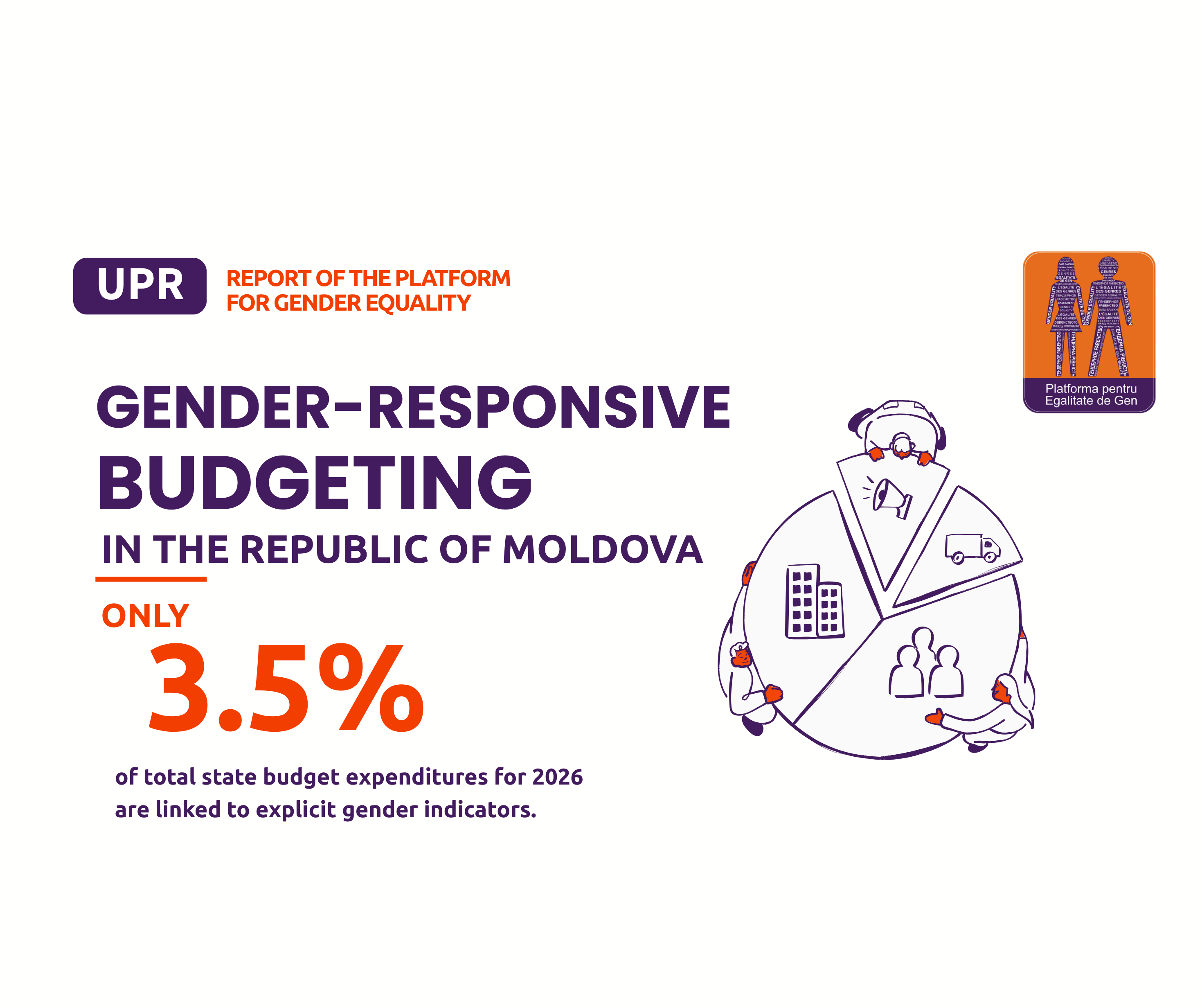
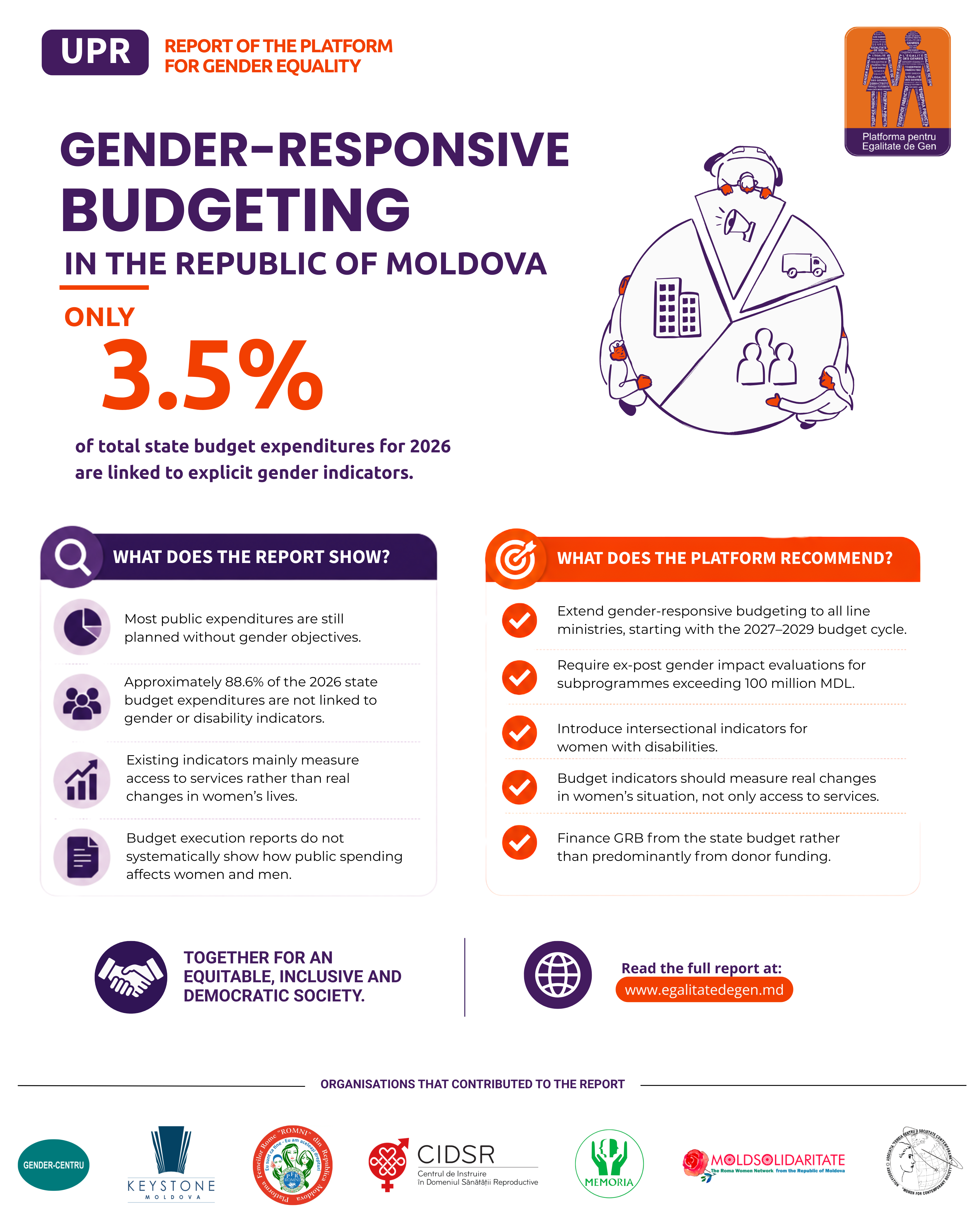
Despite this, most of the reform is still funded by donors rather than from the state budget and most public spending is still planned without gender objectives. Only about 3.5% of the total 2026 state budget expenditure is linked to explicit gender indicators and a further 7.9% to disability-sensitive indicators, while roughly 88.6% remains untagged for. There are also no intersectional indicators for women with disabilities, even where data show women are overrepresented among service beneficiaries. The present indicators measure access to services (outputs) rather than changes in people’s lives (outcomes), and there is still no systematic gender budget statement or ex-post gender impact evaluation. Moreover, budget execution reports do not show how funds affect women and men. As a result, neither Parliament nor the public can verify whether the state budget reduces gender inequalities. The recommendations of the 3rd UPR cycle have therefore been only partially implemented.
Recommendations
- The Government should extend GRB to all line ministries, starting with the 2027-2029 budget cycle. In each upcoming budget cycle, the share of expenditure covered by explicit gender indicators should be increased.
- The Ministry of Finance should require ex-post gender impact evaluations for all subprograms above 100 million lei and publish them on its budget portal.
- Line ministries in the GRB pilot should add intersectional indicators for women with disabilities.
- Budget indicators should measure outcomes: real change in women’s situation, not only access to services.
- The Government should fund GRB from the state budget rather than donors and require gender-disaggregated data in budget execution reports.



Comentarii sunt blocate.